
There is a specific kind of morning that anyone who has been depressed will recognise. You are awake but you have not moved. The ceiling is right there. You have run out of reasons to get up and you cannot manufacture a new one, and the day is just going to sit there waiting for you until it turns into evening.
What people who own animals often say — and what turns up repeatedly in the research — is that on those mornings, they got up anyway. Not because they found the willpower. Because something in the next room needed feeding at seven and did not care how they felt about it.
That is a smaller thing than it sounds and also a much bigger one. It is worth understanding what is actually happening there, because the science is more interesting than the greeting-card version, and considerably more honest about the limits.
What the research actually found
A 2024 study published in Frontiers in Psychiatry did something most research in this area does not. Rather than running people through a questionnaire, researchers at the University of Edinburgh, Stirling and Cardiff sat down and interviewed them properly.
They carried out semi-structured interviews with 16 young adults aged 18 to 26 in the UK, all of whom had a companion dog, a cat, or both. Every participant was dealing with anxiety or depression, and 12 of them had a formal diagnosis of an affective disorder.[1]
The findings were not vague. Five overarching themes emerged: the impact of pets on generalised anxiety and panic, on social anxiety and loneliness, on low mood and stress, on severe mental health and suicide prevention, and on staying well.[1]
That third theme deserves attention, because it is not a small claim to make in a peer-reviewed journal.
It also lines up with the broader literature. A 2025 scoping review examining pet ownership and animal-assisted therapy in relation to suicidal ideation found that among 199 surveyed psychiatric assistance dog users — people living with depression, anxiety, PTSD, OCD and other conditions — 46% reported reduced use of healthcare services, attributed mainly to fewer hospitalisations and lower medication requirements. Studies of veterans with PTSD consistently described a sense of responsibility towards their service dogs acting as a deterrent to suicide.[2]
The mechanism nobody talks about: being needed
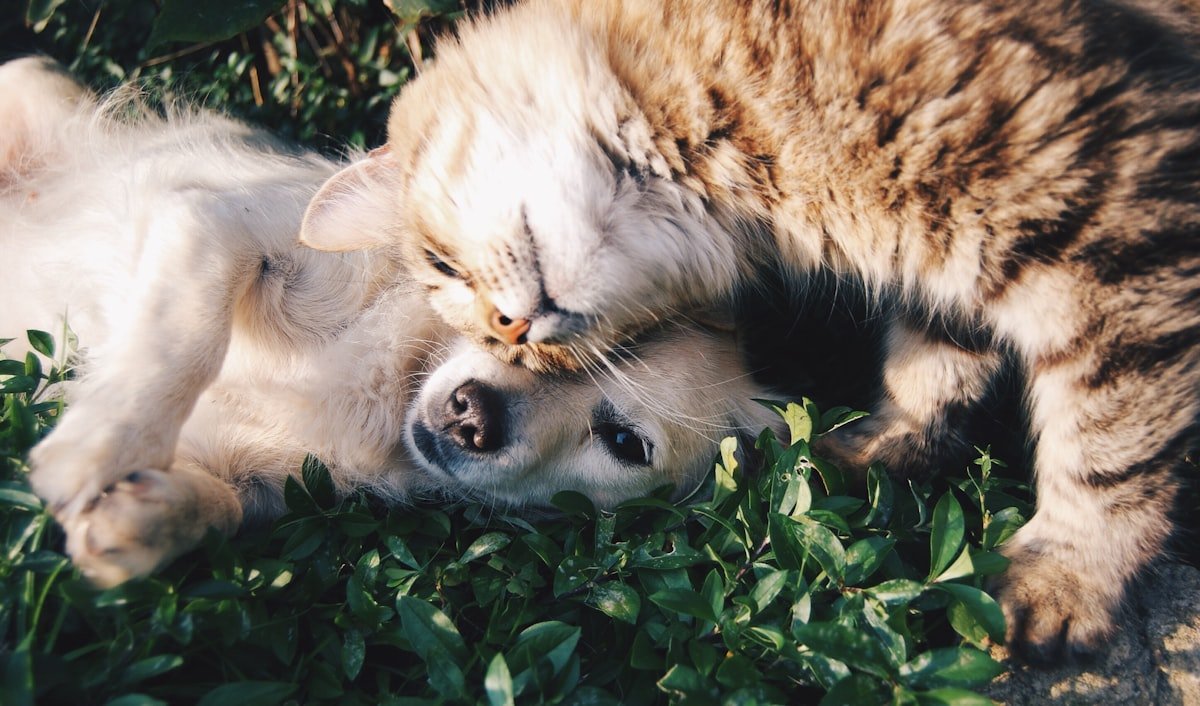
Most explanations for why pets help focus on affection. You pet the dog, you feel better. That is real, but it misses the more important mechanism.
Depression is very good at building an argument that you are a burden — that the people around you would be fine, possibly better, without you. That argument is extremely difficult to counter from the inside, because depression also removes your ability to trust your own contrary evidence.
An animal short-circuits it. It does not offer reassurance you can dismiss as politeness. It presents a fact: this creature will not be fed unless you feed it. You are not optional here. That is not a feeling, so depression cannot reason you out of it.
Psychologists call the resulting behaviour change behavioural activation, and it is one of the most evidence-backed components of depression treatment. Its core insight is that action comes before motivation, not after — you do not wait to feel like doing things, you do them and the feeling follows at some distance behind. An animal enforces that sequence on you whether you have agreed to it or not.
The thematic analyses in that scoping review found exactly this pattern in pet owners’ own accounts, listing motivation and behavioural activation among the mechanisms that reduced suicidal ideation — alongside comfort, distraction and social connection.[2]
The evidence goes back further than adulthood
A cohort study following 571 young people, average age 14, over a mean of 7.8 years found that having a pet dog at baseline was associated with a lower risk of receiving any mental health diagnosis, after adjusting for confounders.[3]
Worth reading precisely, though. The same study found no significant protective effect specifically for anxiety diagnosis, or for diagnoses that came with a psychotropic prescription. The effect was real but narrower than the headline suggests.
Where the evidence gets weaker — and why I’m telling you
This is the part most articles on the subject leave out, and leaving it out does readers a disservice.
The pet-ownership evidence base is genuinely uneven. The 2025 scoping review noted that among the descriptive and case series studies it examined, none provided quantitative evidence or statistical analysis relating to suicidal ideation beyond sample size.[2] Compelling accounts, thin numbers.
And the findings do not all point the same way. The same review reported that while dog owners had lower anxiety and lower suicidal ideation scores than non-owners, cat owners reported more depression and more suicidal ideation.[2] That is not the story anyone expects, and nobody has fully explained it.
There is also a real cost on the other side. The Edinburgh study’s own framing is that companion animals confer both risk and benefit.[1] Participants in the wider literature described increased negative feelings and emotional strain from pet ownership that made their suicidal ideation worse, not better.[2] Attachment that deep does not come without exposure — to illness, to cost, to loss.
So should you get an animal?
Not as a treatment plan. That is the honest answer.
An animal is not a substitute for therapy, medication, or a doctor’s assessment. Adopting one while you are in the worst of a depressive episode is a genuinely risky decision — you are taking on daily obligation at the exact moment your capacity is lowest, and if you cannot meet it, the guilt lands squarely on top of everything else.
What the evidence supports is narrower and more useful than “get a dog and feel better”:
- If you already have an animal, the structure it forces on you is doing real work. Notice it. On the worst days it may be the only thing holding the shape of your day together.
- If you’re considering one, be honest about your capacity on your worst week, not your best. Match the animal to it.
- If you can’t commit, the benefit is not all-or-nothing. Volunteering at a shelter, fostering short-term, or walking a neighbour’s dog gives you the contact and the being-needed without the fifteen-year obligation.
The thing underneath all of it
I think the reason animals reach people that words often cannot is that they make no assessment of you. They do not know whether you are doing well. They have no view on whether you have wasted your potential or handled things badly or become someone disappointing. They register that you are here, and that is the entire evaluation.
When you are depressed, being perceived by other humans is exhausting, because you are managing their reaction to you at the same time as managing yourself. An animal removes that second job entirely.
That is not therapy. It does not replace it. But on a morning where the ceiling is right there and you have run out of reasons — something that needs feeding at seven is a reason, and it will do until a better one arrives.
If the emptiness is the thing you recognise most, our piece on why you can feel empty when everything looks fine goes further into it. If isolation is part of the picture, the research on loneliness is worth reading. And if getting moving is the obstacle, the evidence on exercise and depression covers what actually helps.
References
- Hawkins RD, Kuo C-H, Robinson C. Young adults’ views on the mechanisms underpinning the impact of pets on symptoms of anxiety and depression. Frontiers in Psychiatry. 2024;15. doi:10.3389/fpsyt.2024.1355317
- Impact of pet ownership and animal-assisted therapy on suicidal ideation and suicide deaths: a scoping review. ScienceDirect. 2025.
- Impact of pet dog or cat exposure during childhood on mental illness during adolescence: a cohort study. PMC9532803.
- Role of pets and animal assisted therapy in suicide prevention. PMC9422226.
This article is for general information and is not medical advice. If you are struggling with depression, please speak to a doctor or mental health professional — an animal is a support, not a treatment. If you are having thoughts of harming yourself, contact a crisis line in your country or go to your nearest emergency department.

Mindful Truth Hub publishes practical, research-informed guides on mental wellbeing, relationships, fitness, sleep and healthier everyday habits.